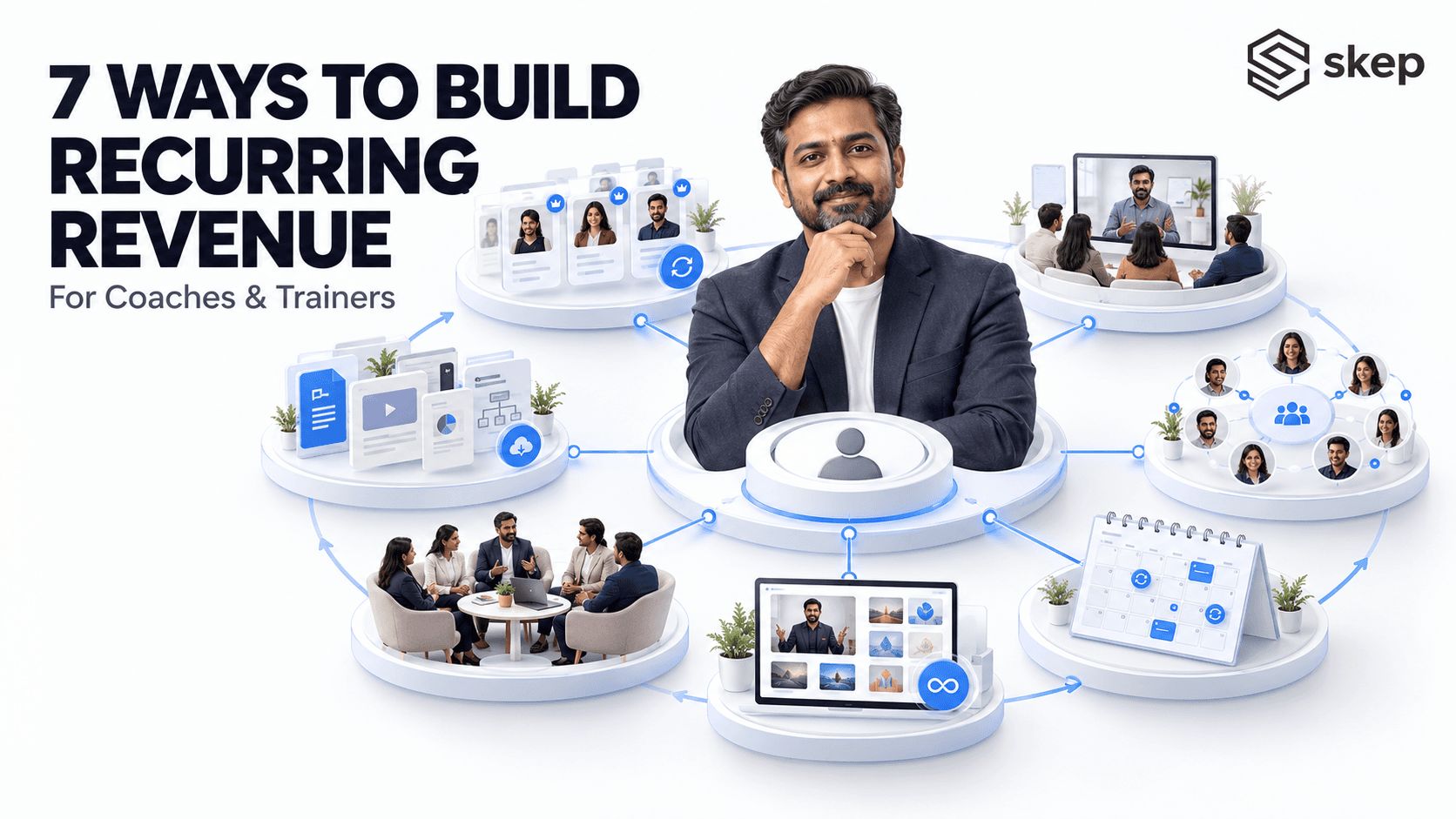
There is a question that tells you how much of your income is actually recurring. If you did no selling at all next month, what still arrives?
For most coaches and trainers the honest answer is close to nothing, and that is true even for people earning well. Most recurring revenue models for coaches turn out, on inspection, to be repeat launches wearing a monthly invoice.
Recurring revenue is a different business
The appeal is obvious. Predictable income, less time spent selling, a number you can plan around. What gets understated is that this is a structural change, not a pricing change.
When you sell a cohort, the work ends when the cohort ends. When you sell something recurring, you have committed to producing value in month seven, long after the excitement of the launch has gone and when nobody is watching. That commitment is the product. The monthly payment is just how it is billed.
Every one of the recurring revenue models for coaches below asks that same thing of you, in a different shape. It is why so many of them start well and quietly die around month four. Nothing went wrong at the launch. The launch was the easy part.
The two kinds that actually recur
Conflating these is the most common planning error, because they behave completely differently.
Subscription recurring. The same customer pays again without making a new decision. They have to actively choose to stop. Memberships, retainers, resource subscriptions. The number that matters is churn, and your job every month is to be worth not cancelling.
Contract recurring. A larger buyer renews on a cycle. Each renewal is a real decision, but it is a scheduled one, and it is made by someone with a budget rather than by someone spending their own money. Corporate programmes, institutional contracts, licensing. The number that matters is renewal rate, and your job is to be visible to more than one person inside that organisation.
The first kind gives you small, frequent, fragile payments. The second gives you large, infrequent, resilient ones. Most stable coaching businesses end up with one of each, and they are run as two different jobs.
Five that recur from individuals
1. The coaching membership
Monthly access to you and to a group of peers, typically ₹999 to ₹2,999 a month.
What makes it renew is not fresh content. It is the live session people have put in their calendar and the room of people who know what they are working on.
The failure mode is the content treadmill. You promise something new every month, deliver brilliantly for three, and then find yourself producing material nobody asked for because you set the expectation that material is what they are buying. If you can describe your membership without mentioning content at all and it still sounds worth paying for, it will survive.
2. The advisory retainer
One client, ongoing access, ₹25,000 to ₹1,00,000 a month. The buyer is usually a founder or a senior leader with a continuing problem rather than a defined project.
What makes it renew is that their problem does not end. They are not buying a transformation, they are buying somebody competent to think with on a recurring basis.
The failure mode is scope. Unlimited access sounds like a selling point and turns you into an unpaid employee by month three. Define the shape: how many sessions, what response time for messages between them, and what is explicitly not included. Clients respect a boundary stated at the start far more than one introduced after you are already resentful.
3. The group mastermind
Eight to twelve people, meeting fortnightly or monthly, ₹5,000 to ₹15,000 a month.
What makes it renew is the other members. This is worth sitting with, because it changes how you run it. In a mastermind you are the convener and the standard-setter, not the main source of value. People stay for the room.
Which means the failure mode is admission. One mismatched member, someone at a very different stage or someone who takes without contributing, can empty a mastermind in two months. Screening is harder work than selling, and removing someone later is harder than both. Interview every person before you take their money.
4. The alumni tier
A lower-priced continuation offered only to people who completed a programme, usually ₹500 to ₹1,500 a month.
What makes it renew is that they already have a result and do not want to lose momentum, plus they want to keep the cohort they went through it with.
This is the easiest of the seven to start and the most frequently missed, because the failure mode is timing. The moment to sell it is the final session, while the group still exists and people are asking what happens next. Three months later the energy is gone and you are selling to strangers who happen to have taken your course.
5. The maintained resource subscription
Templates, trackers, checklists or a reference that you keep current, ₹300 to ₹1,500 a month.
What makes it renew is external change. This model works where something outside both of you keeps moving: regulation, tax rules, platform policies, exam syllabi, compliance standards. Your subscribers are not paying for the documents. They are paying for the documents to be right next quarter.
The failure mode is picking a subject that does not actually change. If month two has nothing to add, you have sold a one-off product on a monthly plan, and people will work that out.
Two that recur from organisations
6. The annual corporate programme
A defined programme delivered to cohorts of employees across a year, renewing on the budget cycle, typically ₹3,00,000 to ₹15,00,000 a year depending on scope and headcount.
What makes it renew is a budget line plus an internal champion who can point at a result. Companies renew what is already approved far more readily than they approve something new.
The failure mode is single-threading. The entire relationship sits with one person, that person changes role, and the renewal evaporates with no warning. Make yourself known to at least three people in the organisation, ideally including somebody a level above your champion.
7. Certification and licensing
Other practitioners deliver your method under licence, paying ₹25,000 to ₹1,00,000 a year each, usually with a recertification requirement.
What makes it renew is that their own business now depends on holding the credential. This is the most durable recurrence on the list, and the slowest to build.
The failure mode is launching early. If your method is not documented thoroughly enough for a competent stranger to deliver it well, you have licensed your name to variable quality and you will spend years undoing that. The honest prerequisite is that you have run the programme enough times to know exactly where delivery goes wrong.
What people mistake for recurring revenue
Repeat launches. Four cohorts a year, reliably, to a warm audience.
That is a good business and it is not recurring revenue. You make the sale again each time, from a standing start, and the income stops the month you stop launching. The predictability comes from your own effort being predictable, which is a different and more fragile thing than money that arrives whether or not you did anything.
Nothing wrong with running it that way. Just do not plan your finances as though it were recurring, and do not be surprised when a quarter where you were ill produces a quarter with no revenue.
Go back to the opening question. If you did no selling next month, what still arrives? That number, and only that number, is your recurring revenue.
How to choose among recurring revenue models for coaches
Start from what you already have rather than from which model sounds best.
| What you have today | Start with |
|---|---|
| A finished programme with graduates | The alumni tier. Warmest buyers you will ever have |
| A few high-value individual clients | The advisory retainer. Convert one and see |
| An audience but no premium offer | The membership. Lowest price, fastest to test |
| Companies already buying from you | The annual programme. Follow the budget cycle |
| A field where the rules keep changing | The resource subscription |
| A strong peer group forming on its own | The mastermind. Convene what is already happening |
| A method documented well enough to teach | Licensing. Slowest, most durable |
One at a time. Each of these is a product with its own delivery obligations, and running two new ones simultaneously is how both end up neglected.
Renewal is a product feature
Whichever you pick, answer this before you launch: what will exist in month seven that did not exist in month six?
The recurring revenue models for coaches that fail almost always fail on this one question. If you cannot answer it, you have designed a one-off product and attached a monthly invoice to it. The customer will notice, somewhere between month three and month five, and the cancellation will feel sudden to you and obvious to them.
The answer does not have to be content. It can be a session that happens, a group that has grown, a document that stays current, a problem that got solved this month. It just has to be something, and you have to know what it is in advance.
Running two or three of these at once
The practical obstacle is rarely the strategy. It is that each model needs payment handling, access control, a place to deliver, and a way to talk to the people inside it. Run three and you are managing three sets of all of that by hand.
SKEP is built for exactly this. A membership handles the recurring billing and the access that comes with it, and can price everything else you sell differently for members, which is what turns a membership into the entry point to your whole business rather than a separate product. Retainer and mastermind sessions run as one-to-one or cohort sessions with the video built in. Each group gets its own space, so the mastermind conversation is not in the same room as the alumni one. Orders and earnings sit in one place, so you can see what actually renewed.
One structure, several revenue models inside it, which is the only way running three of these stays survivable.
Try this yourself
1. Calculate your real recurring number. What arrives next month if you sell nothing? Write the figure down. It is usually sobering and it is the only honest baseline.
2. Pick one model from the routing table. The one that matches what you already have, not the one with the best economics on paper.
3. Write the month-seven answer before you write anything else. One sentence describing what exists in month seven that does not exist in month six. If you cannot write it, pick a different model.
4. If you have graduates, sell the alumni tier at your next final session. Not afterwards. This is the single highest-return action on the list and it takes one slide.
The recurring revenue models for coaches that last are not the clever ones. They are the ones where you genuinely know what you owe people next month, and can deliver it on a week when you are tired.
Pick the one you could still honour in month seven. Then build it before you launch it.
Start building it. SKEP is free to begin. No card needed, and everything in this post runs on it. See the plans for coaches and trainers and pick the one that matches where you are today.
© SKEP
The Launchpad for coaches, trainers, consultants & subject matter experts
support@skep.in