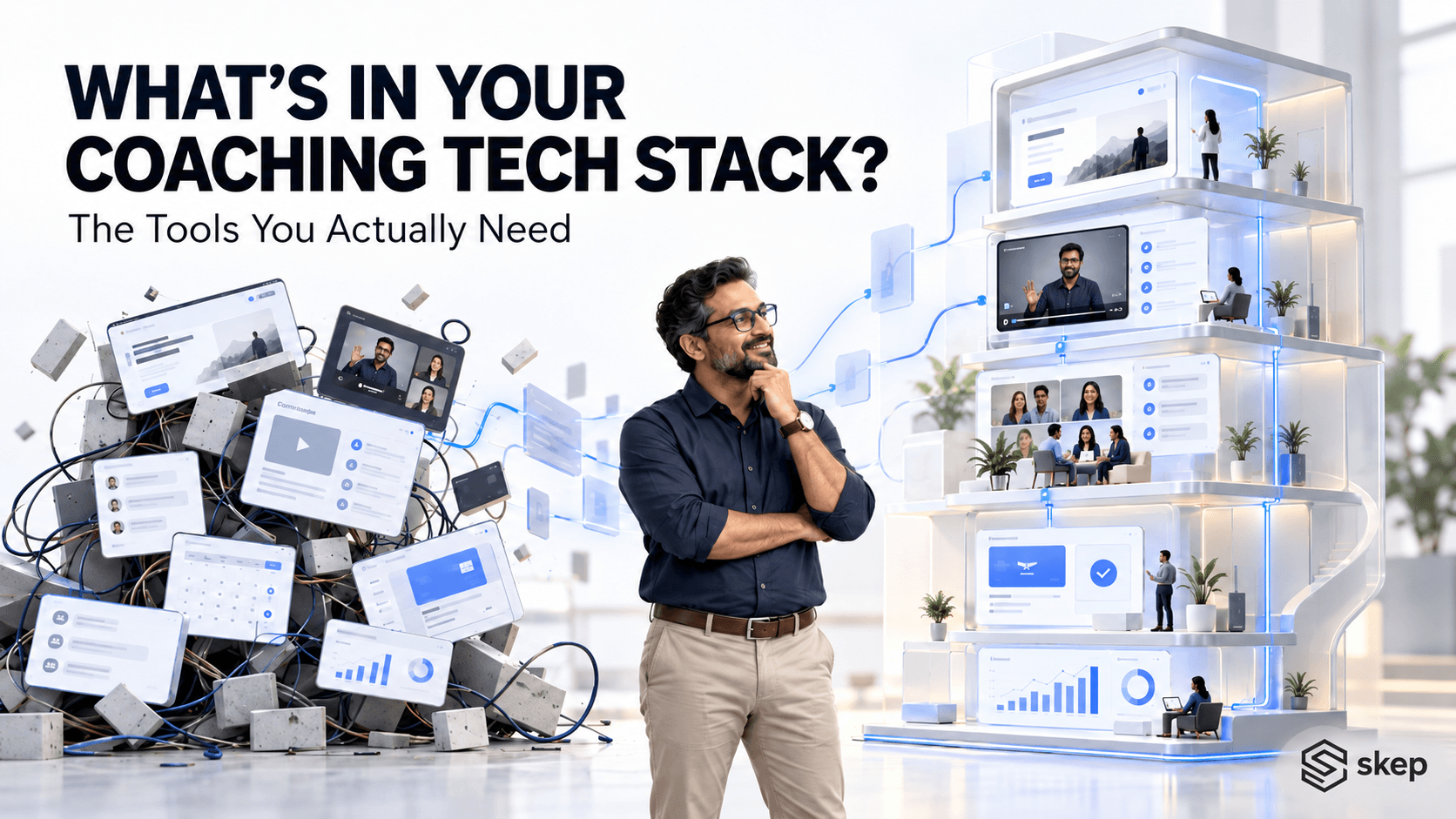
Most coaches and trainers assemble their online coaching tech stack from the aspirational end. Funnels, email sequences, a branded app, dashboards.
Then a buyer pays, cannot find the session link, emails you twice, and you realise the basics were never handled at all.
You are probably buying from the wrong end
A stack is not a collection of good tools. It is the shortest set of things that lets a stranger pay you and receive what they bought without you personally intervening.
That sentence is the test for everything that follows. If a tool does not move you closer to it, you do not need it yet, however impressive the demo was.
What an online coaching tech stack must do
Seven jobs. Nothing clever, and no exceptions.
| The job | What it has to do | What happens without it |
|---|---|---|
| Take money | Accept payment, confirm instantly, handle a refund | You chase transfers and reconcile by hand |
| Deliver live | Scheduled sessions people join without hunting for a link | Every session starts five minutes late |
| Hold the material | One place for recordings, documents and references | "Where was that file?" becomes your support queue |
| Control access | Only people who paid get in, and access ends when it should | You add and remove people manually, and forget |
| Talk to the group | A channel for conversation between sessions | Everything lands in your personal messages |
| Know who bought what | A record of who owns which product and when it renews | You cannot answer basic questions about your own business |
| Prove delivery | Attendance, completion, a credential they can show | No evidence for testimonials, renewals or corporate buyers |
If your current setup fails any of those seven, that is the gap. Everything else is optional.
The seventh is the one most often skipped and the one that matters most if you sell to companies. Corporate buyers ask for completion records, and a trainer who cannot produce them loses the renewal to someone who can.
What you do not need yet
Said plainly, because a great deal of money gets spent here.
A custom mobile app. No programme has ever failed because it ran in a browser.
A CRM. Until you have more leads than you can hold in your head, a spreadsheet beats a CRM, because it is faster to change and you will change it often.
Marketing automation. Sequences are worth building once you know what converts. Before that you are automating a guess, and a guess sent automatically is still a guess.
A website beyond one page. One page with a clear offer and a payment link outperforms a six-page site with a blog nobody reads.
An affiliate or referral system. These need volume before the mechanics matter.
Analytics past one question. Where did the last ten buyers come from? You can answer that by asking them, and the answer will be more useful than a dashboard.
The pattern is worth noticing. Every item on that list is a tool for scaling demand you do not have yet. The seven jobs are tools for delivering what you already sold. Fix delivery first, because poor delivery is what kills referrals, and referrals are your entire demand engine at this stage.
The two questions that matter more than features
Feature comparisons are where buying decisions go to die. These two questions tell you more than any grid.
Who owns the relationship with your buyer
When someone buys from you, do you receive their contact details and the right to contact them directly? Or does the platform hold that relationship and let you message people inside it?
The second arrangement is a marketplace. It can be a genuinely good channel, and plenty of coaches and trainers get real volume from one. It is not your business, though, because if the terms change, the cut rises, or you are quietly deprioritised in the listings, you have no independent route to the people who already paid you.
Ask it directly, before you commit: can I take my member list with me? If the answer involves several sentences, you already know.
What does leaving cost
Every tool is easy to join. Almost nobody asks what happens on the way out.
Can you take your recordings, your member list, your written material, your records of who completed what? Not because you intend to leave. Because the cost of leaving is precisely the amount of leverage a vendor has over you, and that leverage is what sets your price in three years.
The integration tax
The stack you assembled from free tiers has a cost, and it does not appear on any invoice.
Count the manual steps in your current flow. Payment lands, you see the notification, you copy the email address, you add them to the session invite, you add them to the group, you send the materials link, you note it in a spreadsheet. Seven steps for one buyer.
Twelve buyers a cohort, four cohorts a year, and that is well over three hundred manual steps annually, every one of them a chance to miss somebody. The person you miss rarely complains. They quietly decide you are disorganised, finish nothing, and do not come back or refer anyone.
The tax is not the subscription you avoided. It is that you have become the integration layer, and an integration layer cannot delegate, cannot be automated, and cannot take a holiday. Any honest accounting of an online coaching tech stack prices those hours, because they are the most expensive thing in it.
The handoff test
Before you buy anything else, spend twenty minutes on this.
Write out the journey of one buyer, from seeing your offer to finishing your programme. Then mark every point where a person has to move information from one system into another.
Each mark is a handoff. Handoffs are where things break and where your week disappears. A consolidated setup has one or two. A typical assembled stack has six or seven.
This test is more useful than any feature comparison, because it measures the only thing that reliably costs you something.
Three stacks that are genuinely enough
Just starting, one product. Payment, a video tool, somewhere for materials, a group chat. Four things. Accept the handoffs, because you have few enough buyers that doing it manually is genuinely fine. Buy nothing else.
Running regularly, two or three products. This is where assembled stacks break, and it arrives sooner than people expect. Access control and knowing who bought what stop being manageable from memory the moment a second product exists alongside the first. This is the point to consolidate.
Several products, some recurring, perhaps someone helping you. This is the stage an online coaching tech stack is actually designed for, and the stage most people reach before they admit it. Now the seventh job matters, and so does being able to let another person run delivery without handing them the keys to everything. An assembled stack cannot do that second part safely, because access in a collection of free tools is all or nothing.
Where SKEP fits against the seven jobs
Taking the same seven jobs in order, this is what SKEP covers.
| The job | How it is handled |
|---|---|
| Take money | Payments with orders and earnings in one view |
| Deliver live | One-to-one, webinar and cohort sessions with the video built in, so there is no meeting link to distribute |
| Hold the material | Course modules, articles and a searchable reference |
| Control access | Access follows what somebody bought, and memberships handle the recurring case |
| Talk to the group | A space per group, plus a feed and chat |
| Know who bought what | Orders and earnings show who owns what and what renewed |
| Prove delivery | Completion records and a credential carrying a code an employer can verify |
On the two questions that matter more than features, here is the honest position. SKEP is not a marketplace. It does not sit between you and your buyers, it does not list you against competitors, and the member relationship is yours. That answers the first question.
The second question you should put to every vendor you consider, including this one, before you commit to any of them. A platform that cannot answer it clearly is telling you something.
Two other things worth knowing at the third stage above. You can run it on your own domain and branding, so the stack is invisible to your members. And you can give someone else the ability to run delivery without giving them the whole business, which is the specific thing that lets you stop being the only person who can operate your own company.
Try this yourself
1. Score your current setup against the seven jobs. Seven rows, yes or no. Fix the no's in order and ignore everything else until they are yes.
2. Run the handoff test on one buyer journey. Count the points where you move information by hand. That number is your real monthly cost, expressed in the only currency that matters.
3. Ask your current tools the export question. Can you leave with your member list, your material and your records? Find out now, while it is academic rather than urgent.
4. Cancel one thing you bought for demand you do not have yet. There is almost always one. The money matters less than the attention it is quietly taking.
An online coaching tech stack is not a status symbol and it is not a growth strategy. It is plumbing. Its only job is to make sure that the person who paid you receives what they bought while you are asleep.
Get the seven jobs covered, count your handoffs, and spend the attention you get back on the craft you are actually selling.
Start building it. SKEP is free to begin. No card needed, and everything in this post runs on it. See the plans for coaches and trainers and pick the one that matches where you are today.
© SKEP
The Launchpad for coaches, trainers, consultants & subject matter experts
support@skep.in